
Crypto vaults are smart contracts that pool deposits and put them to work in a yield strategy, such as lending, staking or a curated multi-step strategy. You deposit a token, the vault records your share of the pool, and you withdraw your share plus any yield the strategy earned. That is a yield vault, sometimes called a DeFi vault.
The word also covers a different product: a storage vault, like Coinbase's, which holds crypto inside your exchange account behind extra approvals and a 48-hour withdrawal waiting period (Coinbase Help). It protects funds and pays no yield. This guide is about yield vaults.
This guide follows one deposit on Turtle from wallet to withdrawal: what you sign, what you hold, where the yield comes from, and where the risk sits.
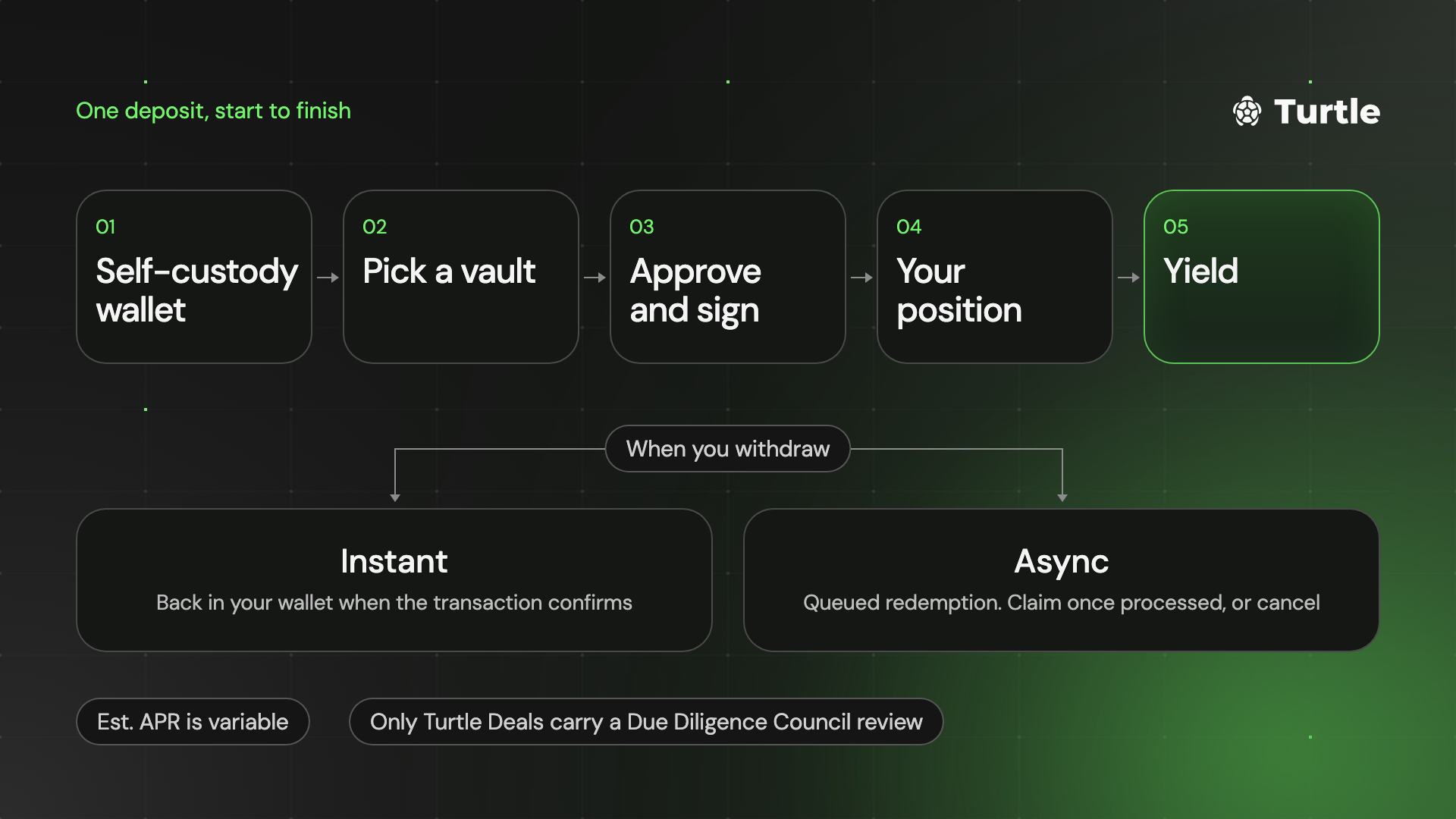
One deposit on Turtle, from your wallet to your position, and the two ways out.
What is a crypto vault, and how is it different from a storage vault?
A yield vault is code you deposit into. A storage vault is an account feature that holds your crypto for you. The difference decides who controls the funds and whether you earn anything.
| Yield vault (DeFi vault) | Storage vault (e.g. Coinbase Vault) | |
|---|---|---|
| What it is | A smart contract running a strategy | A protected balance inside an exchange account |
| Who holds the assets | The vault contract; you hold a claim on your share | The exchange |
| What you earn | Variable yield from the strategy, plus any rewards | Nothing |
| How withdrawals work | Set by the vault: one transaction, or a queued redemption | Approval steps, then a 48-hour wait |
| Main risks | Smart contracts, the strategy, the curator, redemption terms | The exchange itself |
Many yield vaults follow ERC-4626, the Ethereum standard for tokenized vaults. You deposit an asset and receive shares, and each share's value rises or falls with the strategy. A curator is the team that sets the strategy and its risk limits, when the vault has one.
What do you need before you deposit?
Three things, according to Turtle's deposit guide:
- A self-custody wallet that you control. Turtle never receives your keys.
- Funds on the vault's chain. Each vault lives on one network. If your wallet is on another, the app asks you to switch chain first.
- Turtle membership, in some flows. Some vaults require your wallet to be a registered Turtle member, and the app prompts you when it does.

You do not need to hold the vault's own token. More on that below.
Where do you find a vault on Turtle?
The Turtle app lists opportunities on two pages, and the difference between them is diligence (Yield Opportunities docs).
| Page | What it lists | Review status |
|---|---|---|
| Earn | Turtle Deals: vaults tied to a partner liquidity campaign, with extra rewards | Every deal passes a Turtle Due Diligence Council (TDC) review |
| Discover | Every opportunity Turtle indexes, more than 2,700 at the time the docs were written | Only Turtle Deals carry a TDC review; the other listings are indexed without one |
Discover spans Ethereum, Base, Arbitrum, Avalanche, BSC, Optimism, Polygon, Linea, Scroll, Katana, Monad, HyperEVM, Sonic and more, with vaults from protocols such as Morpho, Euler, Yearn, Mellow, Aave, Lido and Lagoon.
The TDC reviews deals across four dimensions: technical, operational, financial and curator risk. Its members work independently of Turtle's commercial team and can decline a deal whatever the commercial relationship (TDC docs). Where a review is complete, the report is published with the listing.
For a vault on Discover that is not a Turtle Deal, the review is yours to do. Read the vault's own docs and audits before you deposit.
What happens to your money when you deposit?
Your tokens move from your wallet into the vault contract, and you get a position in return. Each step changes something specific.
-
You pick a deposit token. If you hold the vault's native token, you deposit it directly. If you hold another supported token, the app routes a swap before the deposit lands. A swap is subject to slippage, the small price move between quote and execution, and the app shows the expected result before you confirm.
-
You approve, then sign. The approval lets the contract spend that token. The deposit transaction then moves the funds. Turtle builds the transaction unsigned, and you sign and submit it from your own wallet (Trust and Security).
-
You receive a position. The Your Position tab shows current value, receipt balance, estimated annual yield and vault share. The receipt balance is your claim on the vault. The vault share is your slice of its total assets.
In an instant vault the position is active once the transaction confirms. In an async vault the deposit is queued and settles later. The docs walkthrough covers the buttons for both.
Does Turtle take custody of your funds?
No. Turtle's docs state, "When you deposit, your assets go into the vault contract you chose, not to Turtle." Turtle never holds your private keys and cannot move, hold or freeze your funds. When you withdraw, the assets return straight to your wallet.
Turtle also does not control the vault or its yield. Those come from the vault's own contracts and curator (Trust and Security).
Where does the yield come from?
From up to four sources at once, and each accrues differently (Track your rewards). The deposit panel lists them under Source / Est. APR.
| Source | Where it comes from | How you receive it |
|---|---|---|
| Native yield | The vault's strategy (lending interest, staking rewards) | Accrues to your position continuously |
| Liquidity Campaign rewards | Token emissions a protocol commits to a Turtle Deal | Calculated when the campaign settles, then claimable in Portfolio, Earnings |
| Streams rewards | Tokens or points a protocol pays on that vault | Claimable as each onchain snapshot lands, or at each cliff for vesting streams |
| Turtle Shells | Leaderboard points on eligible vaults | Tracked offchain, no claim |
Every APR in the app is an estimate. Native yield moves with borrowing demand and the strategy's results, and reward rates change with the token price and the vault's total deposits. Treat Est. APR as a snapshot of current rates, which can change at any time.
Campaign rewards accrue in proportion to the liquidity you provide over the campaign period (Liquidity Campaigns docs). Withdraw early and you earn less of that budget.
How do withdrawals work?
Each vault's own terms set how fast you get out. Before you sign, the withdraw panel shows the withdrawal type and the withdrawal fee.
| Vault type | What happens when you withdraw | Example protocols |
|---|---|---|
| Instant | Funds return to your wallet when the transaction confirms. The panel reads "Withdrawal: On-chain" | Morpho, Yearn, Aave |
| Async | Your request joins a redemption queue and the operator delivers the tokens after the redemption time (the docs example is 36 hours) | Mellow, Lagoon |
A pending async request sits under Pending requests on the Your Position tab. You can claim it once the vault has processed it, or cancel it before it settles to get your funds back. Times are approximate and depend on the strategy and available liquidity.
Turtle's pricing docs state that LPs pay nothing to Turtle. Protocols pay for the liquidity they attract. Any fee in the withdraw panel is the vault's, so read it before you deposit.
Where does the risk sit?
In the vault. Your funds sit in the vault's contracts under its curator's strategy, and Turtle's role is to list opportunities and build the transactions you sign. A vault's risks come from its contracts, how its curator allocates, the assets it holds, and how fast it can return funds.
That makes the vault's own terms the checks that matter. A TDC review covers them for Turtle Deals. Turtle also prices risks it finds in the plumbing: after the LayerZero exploit, it said assets that rely on configurable bridging will be priced with a haircut (Turtle).
Reviewed deals also attract size. Turtle reports that its LPs deployed $10M into Decibel's pre-deposit vaults within 24 hours of launch, after Turtle's due diligence on the protocol (Turtle case study). Those are Turtle's own figures.
Pre-deposit checklist
Run these five checks on the opportunity page before you sign.
| Check | Where to look | Why it matters |
|---|---|---|
| Custody | Your wallet signs every transaction | No one else should hold your keys or funds |
| Review status | Earn page, or the Featured Turtle Deals row on Discover | Only Turtle Deals carry a TDC review |
| Redemption type | Vault details and the withdraw panel: "On-chain" or a Redemption time | Async vaults can take hours or days to return funds |
| Fees | The Fees section and the withdraw panel | Fees come out of your yield or your exit |
| APR sources | Source / Est. APR in the deposit panel | Shows how much is native yield and how much is temporary rewards |
Connect a self-custody wallet and filter by chain, token or estimated APR.
FAQ
What is a crypto vault in simple terms?
A crypto vault is a pool that people deposit tokens into so a strategy can earn yield on them. Each depositor holds a share of the pool. When you withdraw, you get back your share's current value, which includes whatever the strategy earned or lost.
Can you lose money in a crypto vault?
Yes. A smart contract bug, a bad strategy decision, a borrower default or a depegged asset can reduce the value of the vault's holdings and your share with it. Rewards paid in a protocol's token can also lose value. A review lowers some of these risks but does not remove them.
Is a crypto vault the same as a crypto wallet?
No. A wallet holds your keys and lets you sign transactions. A yield vault is a smart contract that holds pooled assets and runs a strategy. You use your wallet to deposit into the vault, and the vault records your share as a receipt balance tied to that wallet.
What happens to a deal before it is listed on Turtle?
Turtle and the protocol set the emission token, reward rate, duration and eligible vaults. Then the TDC reviews the deal across technical, operational, financial and curator risk, and can decline it. Only then does it go live as a Turtle Deal on the Earn page.
How does Turtle help you manage your DeFi positions?
Portfolio shows every position with its value and estimated APR, and the Earnings tab collects claimable rewards from every vault and provider in one table. From any position, Manage opens its page so you can withdraw or follow a pending request.